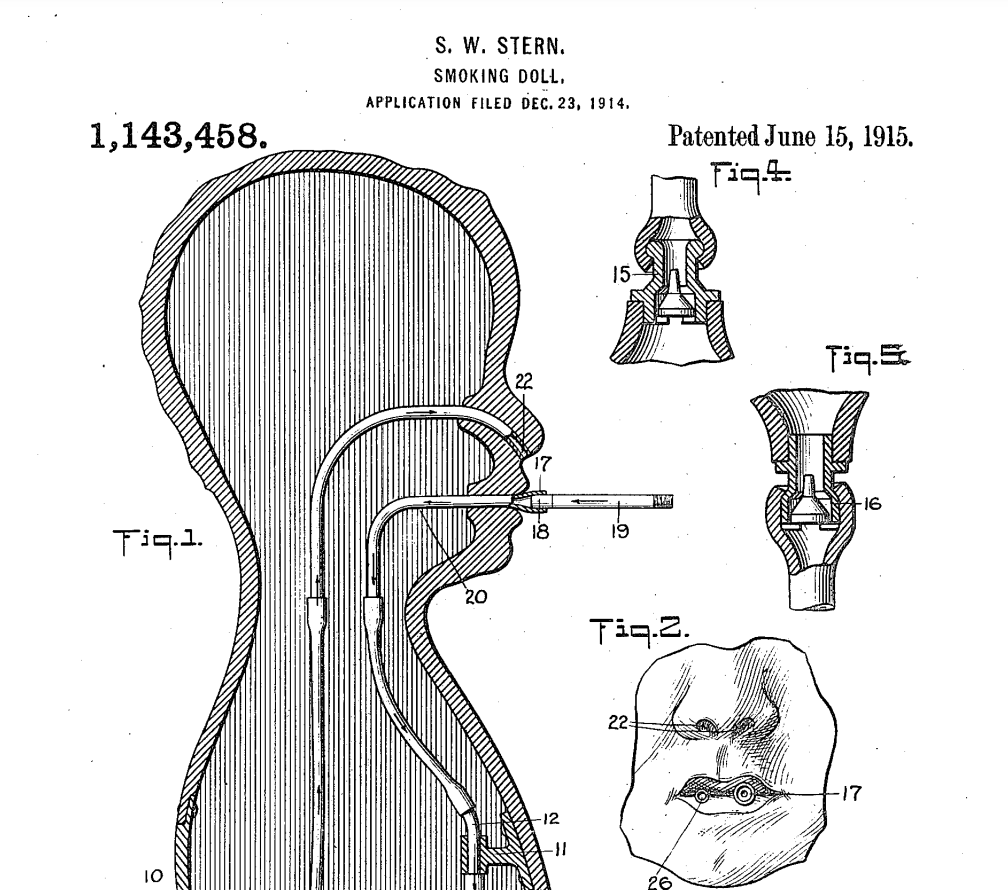
Sales Pitch: Is your tot crying, but they don’t seem hungry, tired, or like need to be changed? Take a deep breath – we’ve got you covered! Simply plug your cigarette into our doll’s mouth and let the secondhand smoke disperse calmness in the crib. They won’t even notice you’ve left the room!
Imagine the terror of the Chucky doll, coupled with the hollow cough of an out-of-gas Model-T Ford. That may well have been what prompted Samuel W. Stern of New York to dream up his smoking doll in 1915. How else to explain his creation?
The profile view (Fig. 1) is that of a baby, but swivel 90 degrees and you’re then staring down the eyes of an emphysemic adult (Fig. 2). Any way you look at it, his doll belongs adrift on the Island of Misfit Toys, surrounded by the raging River of Headspinning Ideas that cuts through the Uncanny Valley.
“In the matter of dolls there is apt to be almost a famine.”
“Santa Claus may have lean pack,” Plainfield Daily Press, Aug. 14, 1914
I don’t dare speculate as to why Stern thought his baby smoker idea would catch fire; what is clear, however, is that his invention came amidst a wave of desperate doll ideas in the 1910s.
Before the First World War, the bulk of America’s dolls arrived in crates shipped from Germany and France. While U.S. toy creators focused on metal and wooden objects of entertainment, the more dainty and precious items were still best made overseas. In August 1913, U.S. companies spent more than US $1.2M on toys from Germany. (That’s around US $37 billion today.) It was a record-high for any month, ever, and less than half of the total spent over the entirety of 1913.
The German export of dolls was booming, and the well-off American families who could afford them were willing to shell out heavily for the pleasure. “The buy [in 1914] was on a still more lavish scale,” reported the Plainfield Daily Press on Aug. 14, 1914, just weeks after the assassination of Archduke Franz Ferdinand. Seeing more and more countries sign on to the war, the reporter foresaw the potential disappointment of thousands of children. Already, trans-Atlantic shipping dwindled and aggression in Europe surged. By Christmas 1914, the reporter predicted, “In the matter of dolls there is apt to be almost a famine.”
That November, toy stores across the U.S. were taking out ads in newspapers, assuring their readers that while others may not have enough stock, they themselves had everything a child could desire. By December, the fear empty shelves dissipated, largely, reports suggest, because American factories picked up the slack. Talking dolls, walking dolls, and, most importantly, American-made dolls filled stockings otherwise left empty by the war.
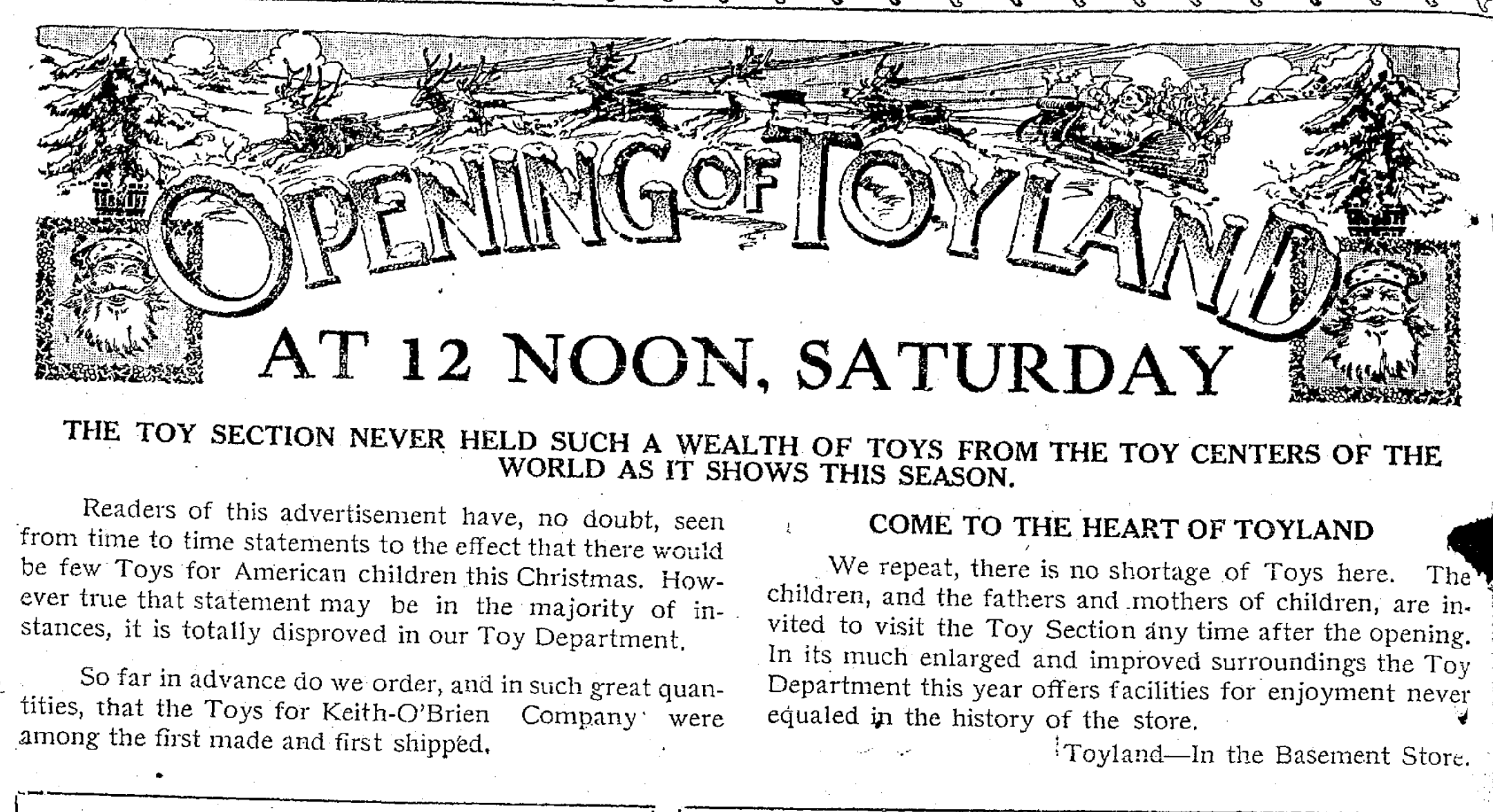
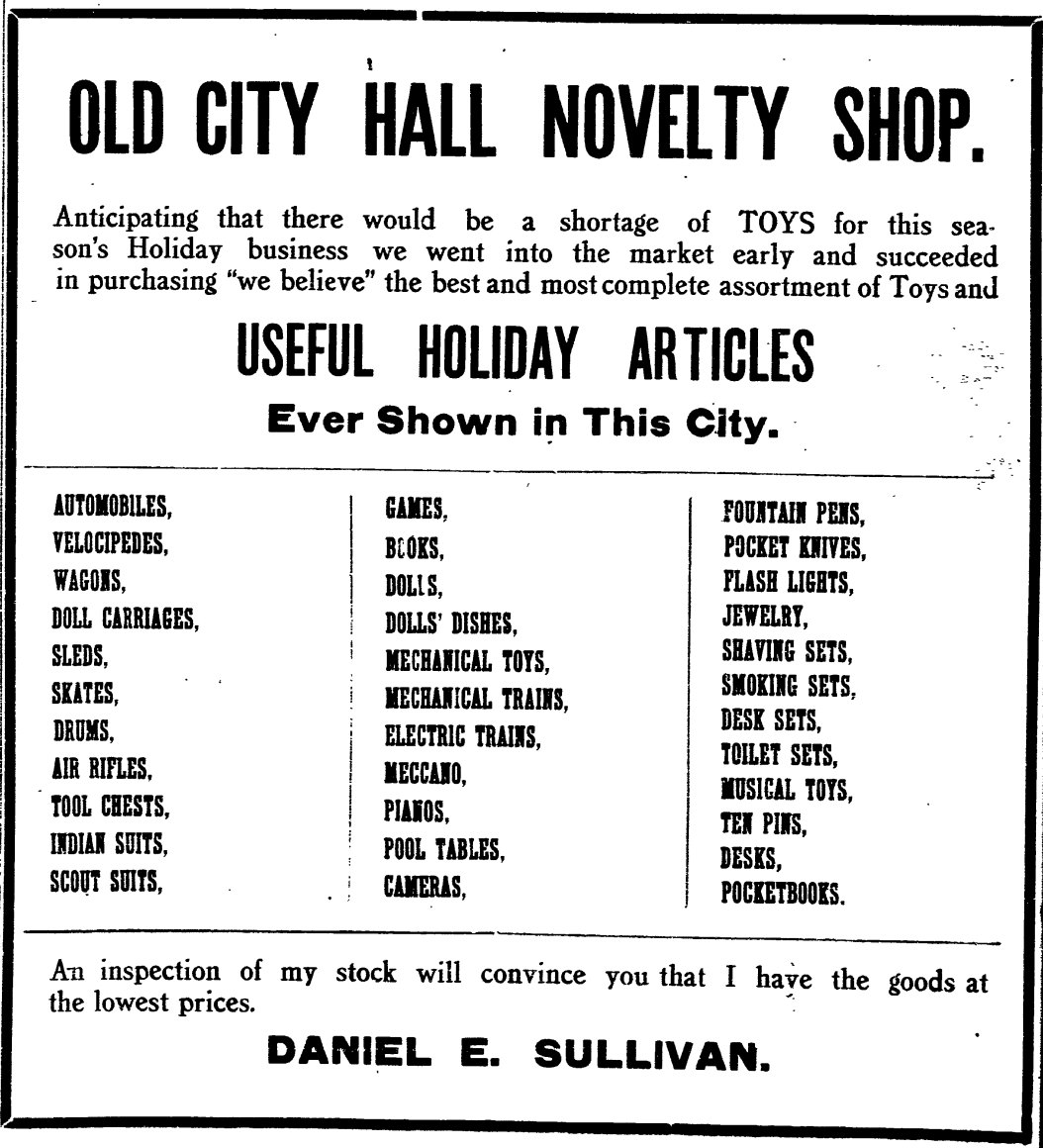
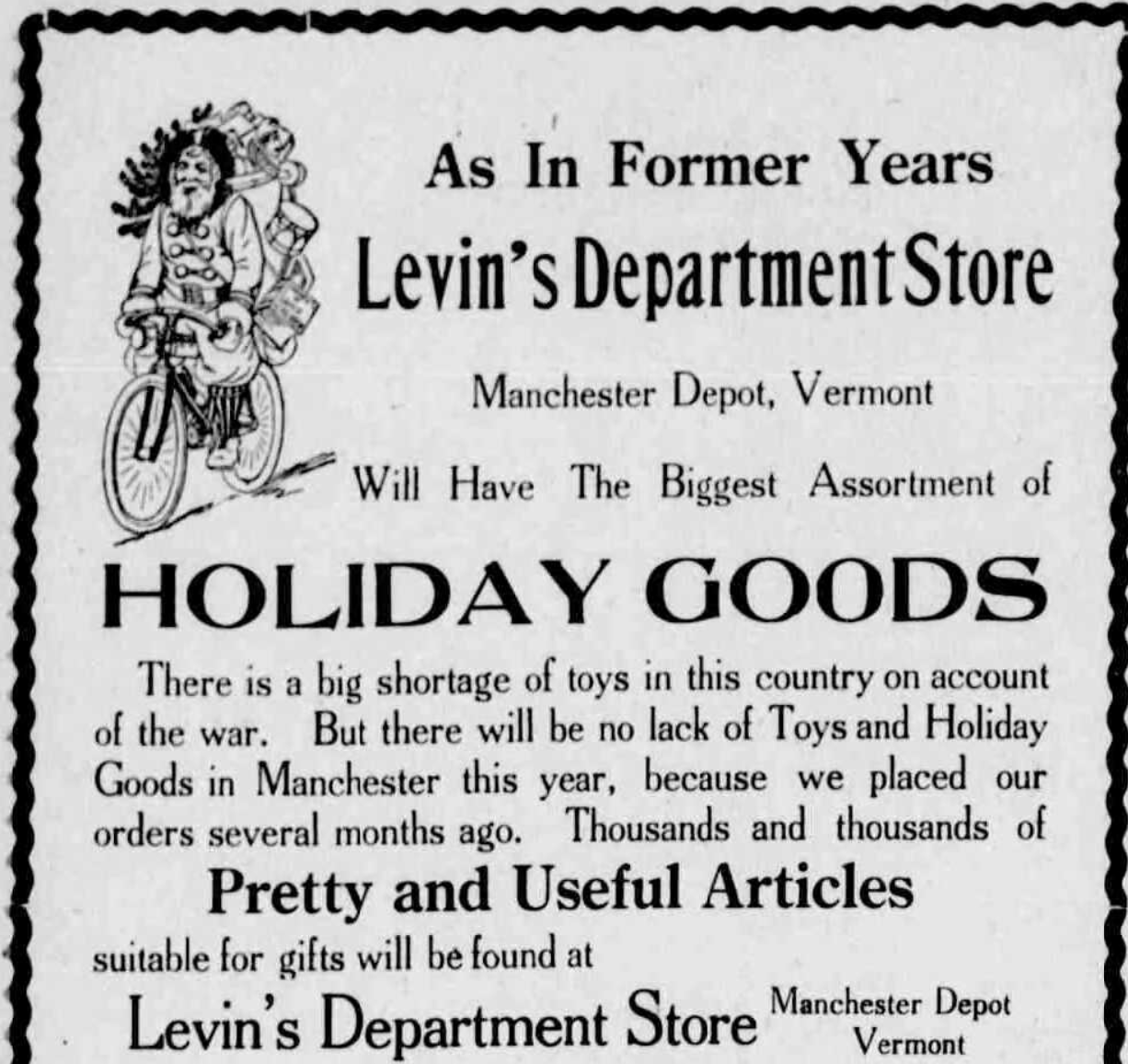

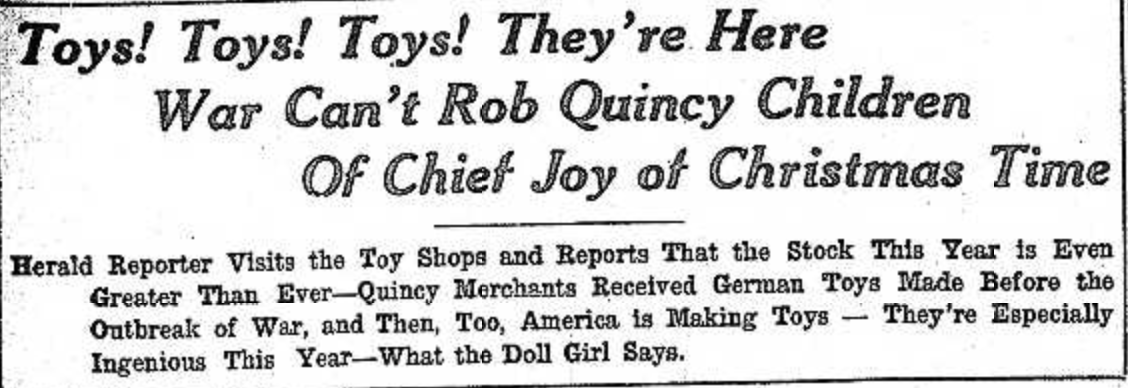
Within six months of the start of the war, Wichendon, Mass., was dubbed “America’s Nuremberg,” a nod to the German city’s toy industry. By that time, around half the town’s population (approx. 6,000 total in 1910) was working in toy manufacturing. As industry boomed in the 1910s, it adopted its Toytown monicker. (There is still a Toy Town Elementary in Wichendon.)
So Toytown grew, and fears of scarcity renewed in 1915, only to be squashed again on Christmas Day. But the brainstorming of American-made dolls had only just gotten started.
Maybe Stern’s doll smokes because it’s nervous about the war – its origins so far are obscure, likely because the idea didn’t take off. But around the same time, an equally frightening image of a much simpler doll, was submitted to a U.S. patent office. It was ready to wipe the floor with the competition.
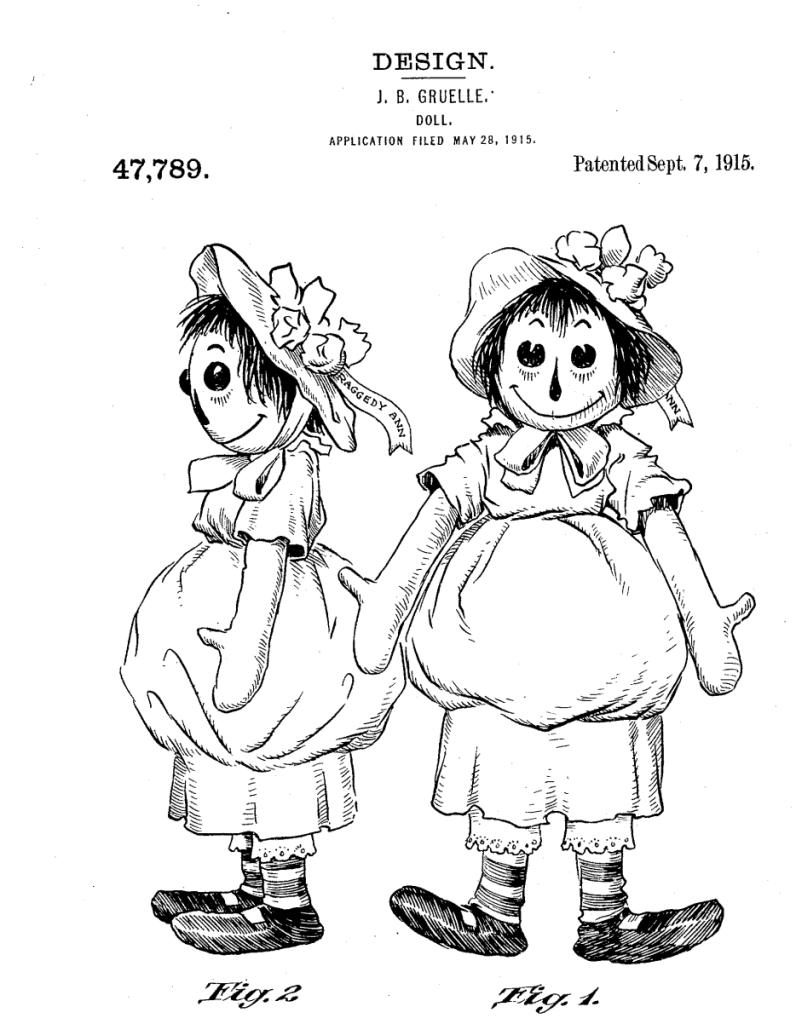
Beyond the health and psychological impacts of a smoking doll, it’s interesting to compare the popularity of the objectively clever invention Stern devised with that of American writer Johnny Gruelle, who patented the Raggedy Ann doll only three months later.
In the end, I suspect Stern sure felt foolish, given the complexity of his creation. His intricate hose-and-vacuum system was no match for an “ornamental doll” that Gruelle dug up in his parents’ attic.
 Patently
Leave a comment