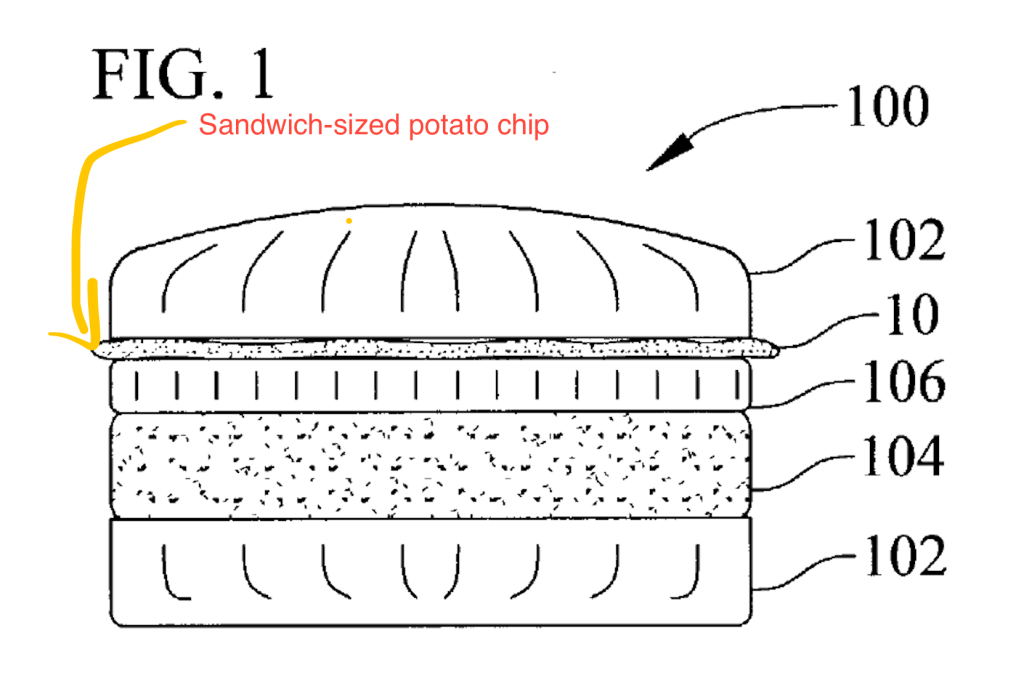
Sales Pitch: Are you a sandwich chain looking to add a snap to your boring menu? Introduce your customers to the Double Crisp Crunchy Chicken Sandwich, featuring a crispy chicken patty topped with a sandwich-sized singular potato chip garnish! Carve out your space in the market today with the added crunch of an extra-big chip.
Judging by the products that lined grocery store shelves at the turn of the millenium, Russell Caldwell’s crispy creation could not have come at a better time. Patented in 2002, his sandwich-sized chip found contemporaries in Vlasic’s hamburger-sized pickle and other, more absurd edible (questionable) concepts. It was a fad food boom.
This was the era of purple ketchup, rainbow bread and a soft drink flavour explosion. Between 1940 and 2000, for example, Mountain Dew had only rolled out three varieties of its nuclear waste of a drink. Through the first decade of the new millenium, the brand unveiled eight more, including Live Wire, Black Out and Voltage – whatever the hell those electric flavours are meant to replicate. But unlike those fad foods, which managed to satisfy the hearts and upset the stomachs of children across North America, Caldwell’s sandwich-sized potato chip cracked before it could make it to customers.
“To get [a patent] issued and to get it marketable are two different things,” Caldwell said in an interview.
That’s not to say the Illinois businessman didn’t try. He focused on fast-food chains, pitching the concept to sandwich shops like Subway and Quiznos as a way to create a new signature offering, akin to the Big Mac or some of Taco Bell’s Frankenstein options. (How many times can you fry a tortilla before it refuses entirely to be digested? Taco Bell is working hard to find out.) While no one overtly bit on his idea, Campbell said, he noticed sandwich chains start to offer chips as garnishes around the same time. “It’s not that they didn’t think that putting a crispy potato chip garnish in your sandwich was not a good deal,” he said, “they just found a different way to do it.”
Unlike a patented widget, where gear A turns shaft B and creates output C, foodstuffs can be trickier to claim ownership over, or at least easier to circumvent. Crushed up chips aren’t perfect, Subway may have assumed, but they’d do just fine in lieu of buying Caldwell out of his idea.
Other forces acted against him too. Despite the rise of flashy junk food, the early 2000s also marked the resurgence of the no-carb Atkins Diet, an arch-enemy for potato-based ideas, if ever there was one.
In Illinois, Caldwell now runs more than a dozen businesses, three of which happen to be restaurants, but they’re not exactly the sorts of places where customers expect a crispy chip garnish to appear. “A crispy potato chip and a sushi sandwich is not going to make it,” he said, referring to the menu at Shortline Sushi in his hometown of Belvidere, Ill. He’s not sure they’d work well on another restaurant’s fire-baked pizzas either.
Caldwell does not rely on patents for a living – his businesses do more than sustain him and his family – rather, the origins of his many ideas is much more relaxed.
“I just don’t golf,” he said. The concept for a sandwich-sized potato topper came because the entrepreneur simply likes stacking his French fries on his burger, but wished they wouldn’t tumble out when he went to pick it up. His time saved from not golfing has manifested in patents on a potato-based burger patty, a flavour core for ice cream cones, as well as an on-board vending machine for airplanes and an array of other gadgets and grub.
Generally, when he dreams up a viable idea, Caldwell explained, “If it seems to be intriguing to me and I don’t see it out there, I will gamble a few dollars to get a patent.” He’s continued to invent, but has steered clear of grocery store ideas since the potato chip.
Food inventions “just seem to be out of my grasp – to monetize them, so I haven’t done any more because it just hasn’t worked out,” Caldwell said, holding out hope.
“One of these days I’m going to run into a company where that’s what they do, and, hell, they can have the whole package for a few bucks.”
Modern Application
It disconcerts the author to write a modern application proposal for this idea, considering that it was created only two decades ago. But as ’90s style eases back into our culture through music and fashion, is it so wild to think that Caldwell’s crisp could join purple ketchup and rainbow bread on a menu of ironic throwback sandwiches, hawked by shrewd Gen-Z entrepreneurs looking to prey upon Millennials’ nostalgia?
All I’m saying is that we’ve all put Bugles on our fingers and hogged guacamole at a party with bowl-shaped Tostitos – maybe a sandwich-sized chip just makes sense?
Find Caldwell’s full patent here.
 Patently
Leave a comment