Accepting that their roads may never be fully clear of snow or ice, several inventors have sought to convert their bicycles into winter-conquering machines. Mostly, their solutions added gears and skis. Read all about three snow bikes below.
1. Ice or Snow Vehicle | 1900
Louis Olson’s creation seems like a prescient imagining of how Dr. Seuss would have the Cat in the Hat tour around town on a snowy day. Two sleigh-like skis mount under a generic bicycle in the Minnesotan’s design, lifting the bike high off the ground and giving it a Whovillian look.
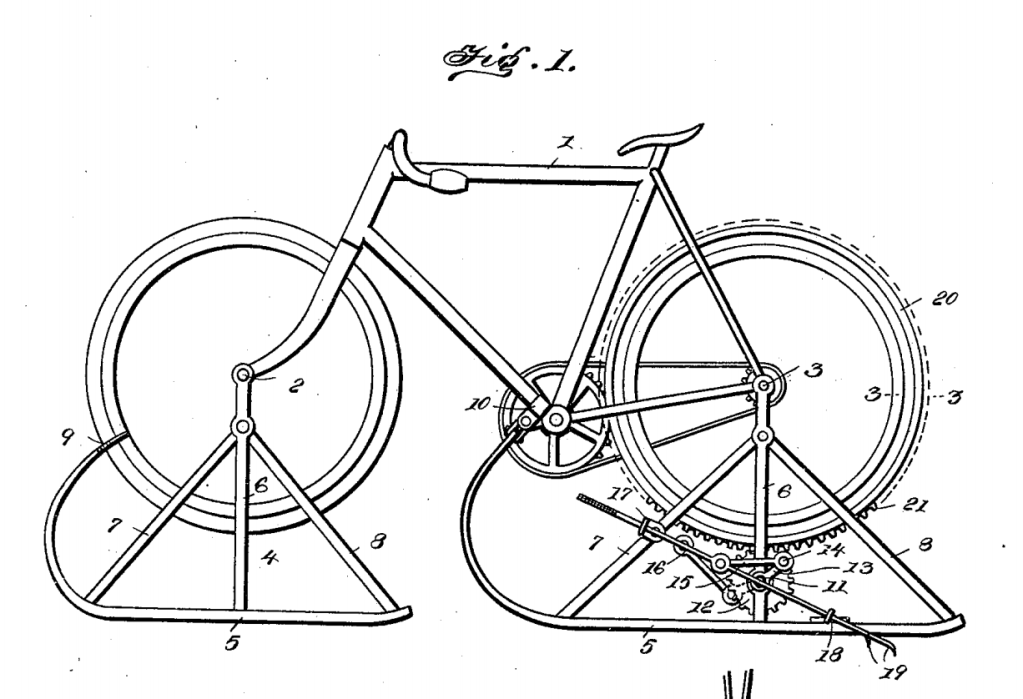
“These sleds or runners, together with the motion-imparting devices, will preferably be detachably connected to the bicycle frame,” Olson wrote, “which therefore may be used, according to the season, either as a bicycle or with said attachments to for a snow or ice vehicle.” That way, Olson thought, users could save money by only having to buy one adaptable device!
The bike-sleigh would work like this: the rider would pedal to turn the bike’s back wheel, just like normal. However, the winterized rear tire, in Olson’s plan, is fitted with gear teeth that interact with another gear installed near the base of the contraption. The grinding system – so long as it didn’t get clogged up with snow, ice and debris – would then drive two steel rods back and downwards into the ice or snow, similar to how a nordic skier’s uses their poles to propel them down a trail.
Through such an arrangement, Olson wrote, “it will be seen that in a vehicle of this character one is enabled to produce an ice or snow vehicle of great simplicity [questionable] and efficiency [to be determined].”
Beyond the challenge of balancing a bike with a raised centre of gravity on two relatively narrow skis, the rider of Olson’s contraption would have also to contend with not knowing how much propulsion they were going to get with each churn of the pedals. The push rods that jut down and backwards into the snow and ice could find no resistance, thus leaving the rider at a standstill. Bicycles, funnily enough, depend quite heavily on consistent motion to stay upright. Coasting, it turns out, is a lot more challenging on skis and snow than it is on wheels and pavement.
Find Olson’s full patent here.
2. Snow-shoe attachment for bicycles | 1896
The third Scandinavian on this list, Emil A. Peterson of Appleton, Wis., was slightly ahead of his contemporary from Minnesota when it came to convertible bicycles.
Peterson’s idea was much simpler than Olson’s, after all. Give the tires more suitable tread and added balance with stabilizing skis and voilà, you’d be ready for whatever winter threw at you.
In theory, consistent wheel contact with the ground would help the rider maintain velocity and therefore balance as well.

Springs and an elastic suspension system were meant to work together to keep the bike suitably suspended on a snow-covered surface, “so as to raise or lower automatically, as the depth of the snow increases or diminishes,” Peterson wrote in his patent.
In theory, the suspension would allow the wheels to sink as far as they need to below the snow’s surface to find suitable traction. In practice, a rider would need to keep up a good speed in order to stay balanced, something that could be an issue if wheels begin spinning in powder.
Of the two bike-based contraptions on this list, Peterson’s appears more viable than Olson’s. But we’re not done yet.
Find Peterson’s full patent here.
3. Cycle Sleigh | 1908
Another one straight out of the Dr. Seuss contraption factory, Charles McCoy’s winter cycle deployed a clawed rear wheel to churn through snow and ice.
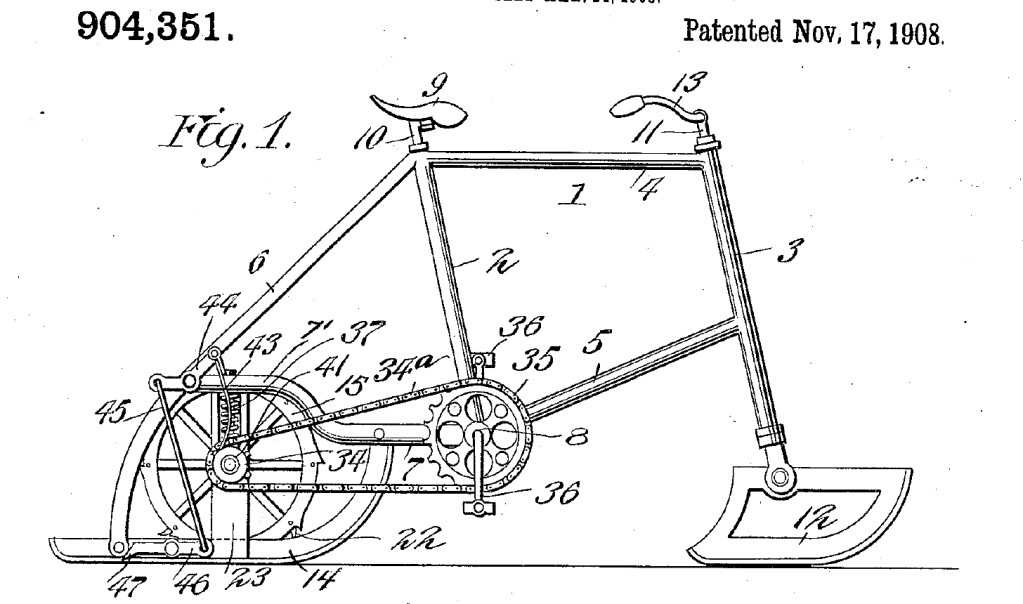
McCoy, of Grand Forks, B.C., may have taken inspiration from the mountains around him to integrate suspension into his device’s rear wheel. The Canadian is also the only of the three bike-sleigh inventors on this list to think about how to brake with his device – an important action for any vehicle, I think the reader would agree.
The fixed chain and rear axel system allows the rider to brake by pedalling backwards, prompting two steel spurs to dig into the ground underneath the rear wheel.
(Side note: When learning to ski, I was told that I was not allowed to ski free from my mother’s arms until I could prove I could stop safely. I insisted that I would simply tip over if I felt the need to quit flying down the hill. This answer was not accepted, but it does feel like Olson and Peterson may have seen it as an entirely appropriate solution).
Find McCoy’s full patent here.
 Patently
Leave a comment