You can slip on it, slog through it, ball it up and toss it, or make a fort; snow season comes with a number of built-in ways to have fun, without much need for accessories or gizmos.
And yet we insist to elaborate on the classic pair of birch boards, once lashed to feet with leather.

Skis, skates and about a zillion iterations of sleds continue to launch with new cuts, colours and concepts. The elementary schoolyard king-maker, the GT Snow Racer (left), proves that innovation can indeed enhance our snow season (and our coolness), but others, like foldable skis and snow-adapted bikes can often just complicate what was originally a simple and effective design.
Case in point: the crazy carpet. Its minimal design maximizes fun and the prospect of broken bones. It’s perfect.
In a completely non-shocking coincidence, many of the most ambitious yet flawed contraptions meant to help humans overcome winter that I’ve found have come from the minds of Scandinavians. Having many Swedes and Danes in my family, this really comes as no surprise. My grandfather grew up in Sweden in the 1930s. Before chairlifts and ski resorts, he and his friends would hop on the backs of horse-drawn logging carts headed up the town’s best skiable hills. The drivers, he says, would flail their whips backwards to try and scare the hitchhikers off.
As I’ve learned from my grandfather’s talk of dodging leather to get free ski runs, it’s best to lean into the season – to grin and bear the stings of log drivers’ whips and winter winds and try and eke out some fun along the way – rather than to actively fight the cycle of seasons and spend four to six months swearing at snowflakes.
But some, like Axel Wettervik of Michigan, have been brash enough to think they could best Jack Frost. At a glance, the inventor’s snow clearing device seemed poised to steamroll the issue of slippery and snowy streets, but the laws of thermodynamics quickly doused its viability.
Snow-Melting Machine | 1920

Wettervik planned to have a vehicle or horses tow two cylinders loaded with hot coals or burning fires over snowy and icy roads, in order to melt the slippery hazards as the contraption lumbered over. The goal of his invention, Wettervik wrote, was to make a machine “inexpensive in construction, strong, durable and efficient in operation, and made in such a manner and of such material that the melting rollers thereof can be economically heated and kept hot.”
The design shows the thoughts of a man who solved the issue of rapidly dissipating heat from the rollers with easy-access doors that allowed for the fires and coals to be fed and stoked on the fly. Despite this consideration, Wettervik’s plan also shows a clear lack of knowledge for how water becomes ice in sub-zero streets.
The rolling furnaces Wettervik planned to deploy would have been challenged to keep their high heat in the face negative air temperatures, even with a human feeding them fuel as they rolled along. But more importantly, the newly melted water they would have left in their wake would, on the average February day in northern Michigan, freeze up fairly quickly, leaving more of a resurfaced ice rink behind Wettervik’s machine, rather than a the steaming gravel street he’d hoped to reveal.
Modern Applications
It shouldn’t be lost on the reader that the number-one ice/snow removal method for streets still involves a combination of scraping and salting – two techniques that were around long before Wettervik. Some jurisdictions have introduced heated roads or paving stones, which melt surface snow and allow it to drain away. But the fact that Wettervik’s machine meant that heat was only applied temporarily to a surface meant that refreezing would always remain an issue. Sometimes, the solutions to the challenges nature throws our way are either so simple to find (shovelling) or out of left field, such as Calgary’s use of beet juice to de-ice roadways.
Author’s Amendment
With a few tweaks and some fine-tuning though, Wettervik’s snow-melting device may well have served useful for the neighbouring Marquette Iron Rangers hockey team as a an automated ice cleaner, beating the Zamboni (invented in 1949) to market by nearly 30 years.
Find Wettervik’s full patent here.
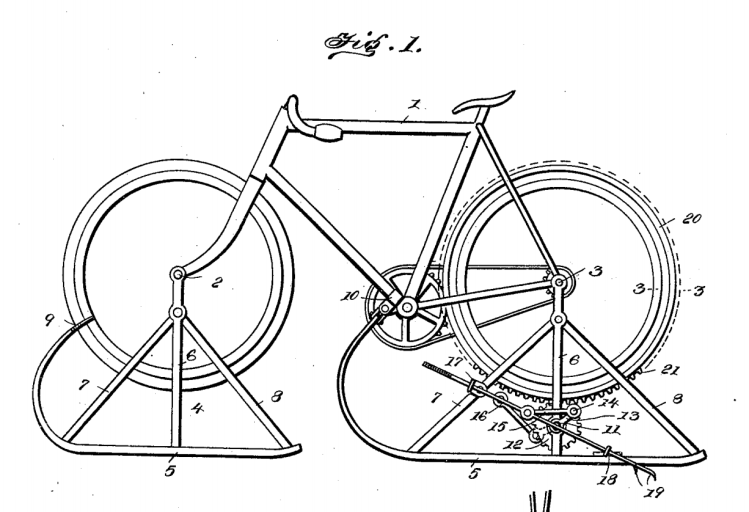
Accepting that their roads may never be fully clear of snow or ice, several inventors have sought to convert their bicycles into winter-conquering machines. Mostly, their solutions added gears and skis. Read all about three snow bikes here.
 Patently
Leave a comment