Sales Pitch: Are your toes feeling a chill of late? Too many holes to darn in your tattered socks? Take a deep breath – help is on the way!
Introducing the Toasty Toes Pedal Calorificator, a portable heating system guaranteed to unfreeze your feet.
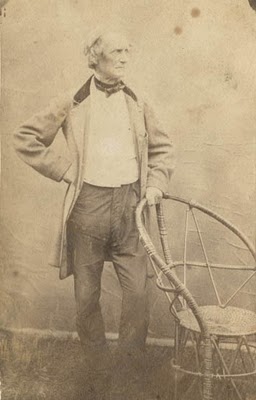
By age 76, it’s likely that William Tell Steiger’s feet fell victim to decreased circulation, as an old man’s feet tend to do. The farmer and former U.S. government cartographer had spent his life in motion in Maryland and Washington, D.C. Perhaps so much so that when he got around to putting his feet up at the end of it all, they felt the blood drain away and give way to a creeping chill.
His wife, Hannah van Patten Steiger, was 28 years his junior and likely so busy filing stories for several local newspapers and magazines that there was no time to knit new socks for her husband.
Left to his own devices, Steiger set about creating a device that could have benefited his namesake, the William Tell of Swiss legend.
Extremities, Steiger posits in his patent, are vulnerable to chill because they’re far away from the lungs, within which, he suggests, “animal heat is generated, and afterward conveyed and distributed to other portions of our bodies by the action of the heart and circulation of the blood.” Swap out “animal heat” for oxygen and he was right – or at least closer to it.
Far away from the body’s engine, he reasons, “The feet, especially, by reason of their immediate contact, in winter weather, with cold floors, as in railroad-cars and other vehicles, and with the frozen ground and icy sidewalks,” received the least amount of heat, because it had further to travel to reach them. It just makes sense.
A man of precision, likely honed through his career in map-making, Steiger set about to see how to more efficiently get the heat from his lungs down to his toes.
He breathed on a thermometer for a short spell to see the mercury shoot up to 88 F, only 10 degrees shy of the body’s internal temperature! He was on to something.
At 32 F (0 C), there was a 56-degree gap that had to try and maintain between his exhale and the crisp winter air, if he wanted to heat his feet in cooler weather.
“My invention aims at economizing and utilizing this wasted heat by any simple contrivance for conveying it to our feet, where it is so much needed,” Steiger wrote in his patent, claiming his device was up to the challenge, though he welcomed modifications.
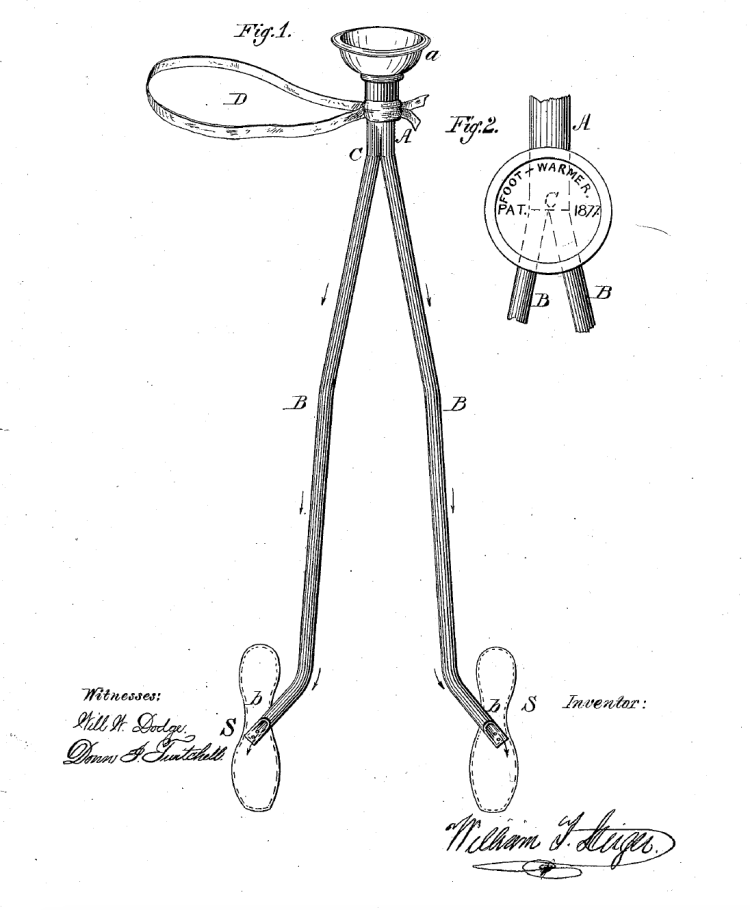
His reverse drinking straw system was simple. A tube, topped with a mouthpiece like that of a trumpet – but not made of metal because that would be too cold, Steiger observed – that fed into a long rubber tube tucked between one’s inner and outer garments, before branching down one’s pant legs and into one’s obviously inadequate socks, or the insoles of a draughty pair of shoes. The mouthpiece could be discretely tucked into one’s waistcoat when not needed.
“I have found, by actual experience, that the tubes in a short time become warmed by the body, so that little heat of the breath is lost in its passage to the feet,” Steiger remarks in his patent, noting that his breath air only fell by four degrees on its travels through the rubber tubes. “After a few sharp blasts of breath at the beginning,” Steiger wrote, you’re off and running on warming feet.
But while Steiger appreciated the science that governed the dissipation of heat energy, his oversight of how volume, containers and gas work together is eyebrow-raising.
First, one has to muster enough breath power to squeeze the air through quarter-inch rubber pipe, heaven forbid there be a kink somewhere down the lines. The air that does make it through the hose would then have to find space in one’s shoes, a pair of notoriously and nearly universally snug-fitting garments. The matter to available space ratio does not check out.
William Tell Steiger’s pedal calorificator would have proved cumbersome and prone to glitches, an exercise for the lungs, if not one’s patience.
Modern Applications
Really, I’m stumped on this one. As a fan of merino wool socks, I’ve never felt the need to breathe between my toes to bring them up to temperature, even in the -30 C winters of Montreal.
There’s an argument to be made the Steiger’s invention could have helped people with chronic illnesses, such as diabetes or others that affect circulation, but there are likely more direct routes to addressing the issue at hand – at foot. Thicker socks might also do the trick.
Steiger’s toe tubes take a simple problem, which already had a simple solution (socks), and complicates the issue. He’s by no means the last to have done so either, when it comes to chilly feet. My grandfather found battery-powered socks in his stocking one Christmas. The socks took C batteries (the large, rectangular ones), which connected at about mid-calf height. The elastics were no match for the weighty batteries. A cozy principle, a crummy execution. The socks did offer us another lesson though. My grandad taught my brother and I to lick the nodes, as a way of checking if there was any power left. It tickled and tasted like lemons.
Author’s Amendment
Steiger’s best modern use of this patent would be to employ the stretchy rubber tubes as a resistance band exercise device, or to burn it in his fireplace with his feet on an ottoman nearby, keeping toasty warm.
Fun fact: William Tell Steiger is the great-great-great uncle of American journalist Maria Shriver.
 Patently
Leave a comment