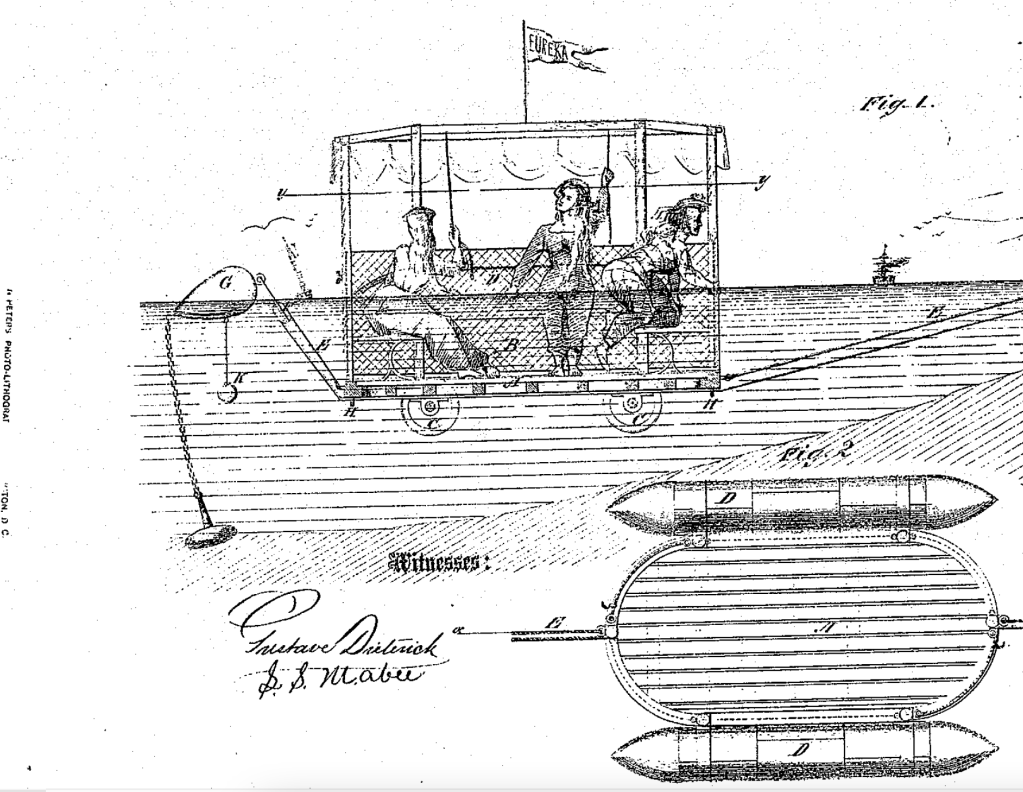
Sales Pitch: Hey you – pasty patriot! Do you love the beach but hate sunlight and swimming, crave that soggy feeling of damp clothes clinging to your body but only on your lower half?
Introducing Captain William Tell Street’s new-fangled tethered bathing vessel, the number-one way to safely slink sous-vide into the Delaware River!
Perhaps it’s that Captain William Tell Street, postmaster, policeman, real estate man and inventor, sought to tether himself to safety after spending the four years of the Civil War as an Acting Master aboard Union warships. Perhaps he was looking for ways to cut loose (figuratively, very much not literally) on weekend trips to the beach. Or, maybe he was just born to explore riverbanks and intertidal zones with caution and modesty.

As a young man, Street moved from his hometown of Frankford, Penn., to Ashbury Park on the Atlantic coast in New Jersey, where he opened the region’s first public bath houses.
“The location of this house is all that could be desired,” reads a newspaper ad for the establishment, developed further after Street moved on from the business. There were hammocks, croquet, boats and a bath house, and a “table supplied with the best the market affords.” Pure luxury.
Extensive indoor plumbing was novel and expensive in the 1850s, much to the bewilderment of one letter writer to the West Jersey Pioneer. “How long will an enlightened community suffer themselves to be humbugged?” the writer asks. “Build a bath-house, if your dwelling house is not big enough to turn around in, and then have every member of your household to use it – You will find nothing so good as PURE COLD WATER.” The letter writer, who is unnamed by the Bridgeton, N.J., newspaper, insists that regular bathing would held ward off disease, and with it, conmen doctors.
Nevertheless, bath houses were expensive and took up valuable living space. Street saw an opportunity at the beach instead. After the Civil War, the inventor developed a sort of swimming harness to which Delaware River bathers could attach themselves, like a bobber to a fishing line, so as not to be carried off in the slow current. “For the timid bather, we think it much safer than the line lying flat on the beach,” read an article from an 1870 edition of the New Jersey Courier. Captain Street displayed this contraption prominently outside one of the largest mansions in the Toms River area. The paper does not mention whether his safety tethers were regularly deployed at the beach.
But with his bathing car, the newspaper proclaimed, Street had created an apparatus that was “destined to become in general use,” “perfected” by the Philadelphia police captain.
Maybe inspired by seeing too many compatriots on sinking ships during his Civil War service, Street’s bathing car design was that of a raft with weak flotation – enough to keep its 10 to 12 occupants’ torsos above the water line, but not buoyant enough to keep them fully dry.
Netting, or a galvanized wire mesh, surrounds the slatted raft in Street’s design, thus preventing its users from floating away in the river current or with the tide, while simultaneously allowing them to feel the current ripple around their waists. The occupants themselves would enter the bathing car on dry land, according to Street’s plans, and would be eased into the water by a pully system, like how a fisherman launches his boat, from a trailer on a sloped ramp into the sea.
“It is manifest that this apparatus affords a very safe protection against the dangers of deep water, and the outward flowing tides or waves,” Street wrote in his patent.
Modern Applications
It’s easy to laugh off Street’s idea, given that the image shows three women in billowing Victorian dresses, which would no doubt become soggy fabric anchors, but the concept of a semi-submersible raft does have myriad practical applications today. From boat trailers to accessibility devices for people with mobility issues, Street’s underlying concept is widely deployed today.
Author’s Amendment
You know how with every trip to the beach, there’s that inelegant moment at the end of the day? When you need to wash the sand off your feet, so you go down to where the water laps gently at the beach? You dip your foot below the surface, shake it and dry it off as you wobble on your yet-unwashed other foot, struggling to neither get your towel or newly clean foot sandy? Then, you delicately repeat this flamingo dance with the other foot. What if there was a single-person Street-style invention that allowed you just to dip up to your ankles and remain out of the sand?
Or, I guess a beach foot-wash faucet works fine too.
Home
Stay updated and see our current exhibitions here.
 Patently
Leave a comment